This is the first blog entry I've written in a while, so if it seems boring, please bear with me.
My favourite short story of the unit was "Thank You Ma'am" by Langston Hughes. I found the conflict in the story interesting- a boy and a woman, both out late, both having done bad things previously in their lives. I know that Langston Hughes mainly wrote about issues of civil rights, and although it wasn't directly stated, I get the feeling that in terms of skin colour, the boy was African-American, and the woman was white. I get this feeling because while the woman had a pocketbook and a purse, and could afford to give Roger $10, Roger had next to nothing, and apparently no family to go home to, something common of African-Americans back in the 1920's. The way Hughes phrased the characters' speech gave a good hint as to the time of the story, as majority of the things the two characters said would be very different today- instead of saying "I were young once and I wanted things I could not get.", the way Luella did, we would now say, "I was young once and I wanted things I couldn't have."
Sunday, September 5, 2010

Friday, May 28, 2010
This I Believe- Perserverance

I believe that people should always see things through to the end, no matter how tough they may seem. This may just seem like advice for school, when you’re stuck on a long essay, and you’re having trouble thinking of a topic sentence, or when you want to give up on your maths test because you forgot to study, but it’s also true for life in general.
Last year, I was being bullied in school. The bully only ever did things to me after Tae Kwon Do, an activity which we had together. Since we had half an hour to wait for the bus, he had ample time to hurt me, mainly physically, but also with words. He would kick me around the hallway, slammed me into lockers. He had power. He was a black belt, whereas back then I was only a blue belt. His punches stung, but his words were almost worse. His words were irritating, and I couldn't do anything about them. I couldn't come up with any response, and if I lashed out, he would start hitting me again. If I tried to run after him, he would have gotten away, since I was far slower. I could almost deal with it after school, since I was the only person effected.
But then, one day, I was walking around with my friend at lunch when we happened to bump into the bully with his friends. A fight then ensued. After being hit in the chest and arm a few times, I ducked around the corner. I’d left my friend with them. In an act of self-preservation, I’d let my friend fight them off alone, whilst I was round the corner, doing nothing.
I apologized to my friend afterwards, and he was fine, but I felt extremely guilty about leaving him. I had given up on defending myself, given up on defending him, given up on resisting the bullies. My selfish act had made me no better than the bullies, letting my friend take the hits, without intervening to help him. I should have stood up for both of us, not let him have the power to beat us up. Had I stayed there, we might have been able to persuade them to stop, might have been able to keep them away. After this, I vowed that I would keep on going in not just fights, but anything I was faced with. In the words of Lance Armstrong, “Pain is temporary. It may last a minute, or an hour, or a day, or a year, but eventually it will subside and something else will take its place. If I quit, however, it lasts forever.”
If we all kept going, surely there would be more achievers in the world, less people that would be jobless, less that would feel disappointed. If you don't give up, and you go out and meet your goal, the happy feeling inside is contagious. You have to share it with others, tell them about what you've done, let them see what you did and aspire to do the same. There are many people I look up to, and I know that if I persevere, I can achieve the same, if not more than what they can. It's not like doing great things is going to be easy; but if you start with small steps, you really can achieve something massive, without really noticing.
As said by Eleanor Roosevelt, "Where, after all, do universal human rights begin? In small places, close to home - so close and so small that they cannot be seen on any maps of the world. Yet they are the world of the individual person; the neighborhood he lives in; the school or college he attends; the factory, farm, or office where he works." There are political situations where people stand up, don't get crushed and keep coming back to fight for their cause. The same thing happens everyday, albeit on a smaller scale. If I'd stood up to the bully, I could have been the small, valiant resistance, defying the large, dictator-like ruling party, the subject of the picture I put here. The picture features Myanmar civilians protesting, standing up for themselves and their right, continuing to stand there, even after laws had been made to get rid of protesters and protesters were being shot.
If you stand up and see your actions through, you really can bring about great change, even if you're in a small-scale situation like I was. I could have made the bully realize that he really didn't have the power that he thought he had, shown him that I wasn't going to let him bully my friends and I.
I could have stood up and made a difference. I didn't. But now, I can go out and keep seeing things through, do anything I want, amaze people, and be the one that people look up to. I still have a chance. The bruises from the punches and kicks are now gone, but the guilt of leaving my friend is still with me. Seeing things through till the end won’t get rid of my guilt, but it can prevent me from feeling more.
Image citation-
"2007 Myanmar protests ." 2007 Myanmar protests 11-cropped flag view closer. Web. 31 May 2010.
Tuesday, May 4, 2010
The 1066 Games Reflection
The 1066 games were both very entertaining. In the first one, you got to select your leader (William or Harold), and answer a series of tactical questions to determine the winner. In the second, you choose your army and your battlefield, and them wage war. I found they both helped a bit with my strategy, with the first one showing the tough decisions kings had to make, and the second being just like a rugby game. I found the second one was easier for me, since the tactics are similar to those of Risk and rugby, with all the clicking of a computer geek. However, I didn't find them historically accurate. All the information I learned about the Battle of Hastings was from class, not from the games. The book told us that the Battle of Hastings was directly after the Battle of Stromford Bridge, and the English soldiers had been marching for to days straight before Hastings. The Normans came in from the sea, and completely slaughtered the exhausted English, making William the new king. It was speculated that Harold died with an arrow in his eye; however, this is unconfirmed. The games don't show this at all; however, this is what makes them fun. If you knew the outcome of each army, would you play? I wouldn't, since no strategy is required! I found that the games did help you remember the places and competitors though; you tend to remember things that are fun, such as the two games. Overall, I'd give them a 4/5 rating, taking everything into account.
Wednesday, April 14, 2010
What are the Consequences of Conformity?

Personally, I believe that this quote is an extremely powerful philosophical dilemma. This dilemma also leads to another- "Can you still be a good person, without acting on bad things happening all around you?" This question has many answers, based on many viewpoints. What follows is what I think, what, deep down, my heart feels is correct.
If you accept the situation and do nothing to act against it, you are saying that you agree with the situation. Now, this may be good if the people are keeping a mutual relationship, but when one side is way worse off than the other, and the other side is not helping them or doing all they can to keep the other side worse off, then something needs to be done about it. Someone has to take action. If you are a bystander, you aren't helping the worse off side. You may not be directly doing them damage, but by not standing up for them, you are letting the opposition tear them to shreds! Now, when you stop and think about this, who is getting an advantage based on you not acting? The opposition are. Essentially, this means you are helping them, and by helping, you show that you agree with their arguement. The consequence of this is that one side winds up being hurt, maybe even killed. You may think that you'll never run into another Holocaust-like situation, but actually, you find smaller versions of them all around you. In school, if one guy is bullying another, the situation is the same. Are you going to accept that the bully can bully people? I wouldn't! Even if you don't walk up to the bully and tell him to go away, you can still tell someone else, like a teacher, principal, or any other adult with the power to do something. This may not necessarily work in war, since there may not be a higher power to go to, but you can still stand up for your rights and others'.
I may want to stand up, but when the lives of myself and my family are on the line, would I? Hopefully I would, but it takes a lot of courage to stand up like that. The people of Le Chambon-sur-Lignon had an extreme amount of courage, sheltering the Nazis' victims in their homes for years. They literally risked everything, just to keep other people safe. Why did they do it? There are two reasons. One was that if they didn't they would be equally as evil as the Nazis. The other is slightly more complex. A century or two before the Holocaust, the people of Le Chambon were also taken prisnor, also under attack, and knew how horrible it was not to find shelter. The empathised with the Jews, and let them stay. If everyone did things like that, the world would almost certainly be a better place, full of empathetic, kind citizens. I think that John Boyne, the author of the aforementioned book, The Boy in the Striped Pyjamas, tried to hint a little at this. Bruno could be compared to Le Chambon, the minority in a Nazi world, helping Shmuel. Although Bruno didn't knowingly help at first, he showed so much sorrow and regret after he lied to Kotler about Shmuel, that he started making an effort to help him. He also used empathy to realize what his best friend was going through, similar to how the people of Le Chambon were empathetic towards Nazi targets, as the people of Le Chambon had been through a similar experience. Although Bruno hadn't gone through the same as Shmuel, he said all the things that Shmuel said, and realized just how horribly tragic Shmuel's life was. His dad and sister, along with Kotler and the other Nazis, represent Germany. They tore apart the Jews, put them down and tortured them.
In the newspapers, stories tend to be uncommon, and therefore interesting. Now, going on this logic, since the newspapers feature people who help out, that makes our race one that is less likely to help out. One day, I would like there to be a world where the newspapers have stories of people not helping out, meaning that more people do, in fact, stand up for their rights, for others' rights. For a world to be like that, we need to "Start in small places close to home." -Eleanor Roosevelt.
I chose the image at the top because of its true portrayal of The Boy in the Striped Pyjamas. Bruno and Shmuel are like lights in the darkness, the chaos, that surrounds them. Also, the light comes from eyes, a major motif in the book. This also links into "seeing the light", in that Bruno only sees the goodness in the Jews after talking to Shmuel, without being under his father's Nazi shadow.
Image Citation-
"Eyes in the dark." Flickr. Web. 15 Apr 2010. .
Thursday, February 18, 2010
Steve McCurry- A Sensational Photographer

Children at Play
Steve McCurry, born February 24th, 1950, is an American photographer and journalist. He is best known for his photograph “Afghan Girl”, featured on the cover of the National Geographic magazine in 1985. McCurry graduated from the College of Arts and Architecture at the Pennsylvania State University. After working for a newspaper company for a couple of laps, he left to India to go freelance. It was there in India that McCurry learned to wait and watch people going through their days, “If you wait, people will forget your camera and the soul will drift up into view.” The focuses of most of McCurry’s photos are of people, either portraits or full shots, portraying them going about their daily life in different ways and of where they live, as well as conflict and labour. Some of his photos have children with limbs blown off, some show people whose faces look unimpressed, sorrowful, enraged or depressed. The photos that do not relate to conflicts are of either his personal misadventures abroad or of sights Westerners do not normally see, such as the sinking of Ganesha statues or of the water under his plane just before it crashes.
One photo that really stood out to me was the one in Kandahar, Afghanistan, the first in the Children at Play section. In the centre, there is an old-looking abandoned tank on the road, with children climbing and shuffling up the tank’s barrel. I feel this picture reflects a range of viewpoints. One of them is that in Kandahar, tanks are almost commonplace. This is achieved via the men cycling past on the road, going about their business, not seeming to particularly care. The tank is stopped in the middle of the road, with no soldiers running towards it, also helping prove the point that it is not uncommon and that no-one seems to care. If it was unusual for children to be climbing on your tank, you’d run out and see what they’d be doing. I get the feeling that McCurry was trying to emphasize that in these parts of the world, people are so familiar with war and its impact, of its machines and weapons. Children always will play and do the same thing, no matter where they live. The children are climbing on the tank, just in the same way that Western children would typically climb trees and climbing frames. “No matter how dire the situation, how dangerous the environment, children need to play.” (McCurry, 1994) I agree with this quote, as I believe that children should not be put to work when they should be learning and relaxing. Their bodies cannot take the strain of the work, and when they haven’t done anything wrong they do not deserve to be shot, bombed or attacked. They also should be learning to achieve something later in life, so they can support their family and hopefully bring themselves above the poverty line. I have also seen children playing around when they should be working, both in my social circles and when I go on holidays all around the world. McCurry possibly took the picture not only to show that tanks are common, but to make people realize that although different things happen, children are the same world over, that we have very few differences. Seeing the picture in this light helps people connect, and once others believe that we are all the same, world peace may be a reality, since war is started over differences and greed. Looking at this picture, I feel a mix of emotions, a happy sadness. I’m happy that the children are playing, despite their lifestyle, and getting time to relax and unwind. However, the sad part is there is massive potential for the children to be killed, put to work and shot. They have a disrupted education and have many rights alienated (to relax and play, to have an education, to safety, to a free life, etc.). I feel McCurry tried to reflect all of this is his photo, and I also believe that when he took the picture, he felt the same emotions that I feel viewing it.
“The road to hell is paved with good intentions. The problem is that intentions which are based on faulty assumptions are doomed to failure.” (McCurry, 2009) Many places are not making use of aid, which is the true definition of hell. Hell is where no matter how hard you try, you can never get out of the rut you’re stuck in. It is a torture, as you’re still in the rut, tiring yourself out trying to get out and beginning to lose hope. Hope is the most valuable commodity in this world. Without hope, many humans have no reason to live, as they always want more than they have. The only thing you can cling to that keeps you happy and continues to help you live a happy life is hope. Without hope, you know something will never happen, and give up trying. When you give up, there is no possible way to get better, and you stay the same forever. That is what hell is, when you lose all hope of things being better and accept that you are doomed to a life of torture. McCurry’s photos show in even dire circumstances, his subjects cling on to that glimmer of hope, the glimmer so visible in their eyes.
Overall, McCurry’s work has helped me realise just how powerful photos can be. They can bring about change. They can inspire action. They can even make people realise how fortunate they are! How can a simple photo do all this? The answer lies in the people. When we see a gun, we just think “Oh, it’s a gun.” When we see men shooting at each other, we think “Woah, it’s a war! I never knew this was happening! Life must be so hard for those people!” I believe this is because we connect more with humans, as they are basically the same as us, with the same needs and rights. People’s faces can also convey many emotions. When you see a gun, the gun cannot show the emotions it feels. When you see a human, you see the fear, rage, regret and sorrow on their faces. We can relate to their emotions, only our personal experiences of them aren’t as life-changing as theirs. Photos are a constant reminder of the past and present. Faces are permanently captured on a lens. The emotions don’t change, not ever. These emotions make others want to help the photographed people out. It’s a natural human need. We don’t enjoy being in pain, in depression, in life threatening situations, so surely others are the same? We feel pity for them; therefore we search for ways to help them. Photos show reality. Real suffering, real people, real wars and real joy. On TV shows, things are normally staged, yet in photos, it’s all real. A good photo reveals the emotions in a certain situation; therefore allowing us to connect…it only takes one country declaring war to change the tables. Photos help us empathize, to understand the terrible pains and wondrous joys other must have. As McCurry said, “If you wait, people will forget your camera and the soul will drift up into view.”
Wednesday, November 4, 2009
Double Blog Post Madness!!! Part 2
Welcome to part 2 of my Double Blog Post Madness!
Now, I'm going to talk about how Pokemon is realistic. I mean, you see Pidgeys and Spearows flying through the skies too, right?
Just joking. I honestly don't have much to say now, so I'm just going to fob you off with a book quote. Sorry!
Actually, I'm going to give you two quotes, because it's my favourite book I'm quoting- CHERUB: The Recruit!
"James Choke hated Combined Science. It should have been test tubes, jets of gas and sparks flying all over the place, like he'd imagined when he was still at primary school. What he got was an hour propped on a stool watching Miss Voolt write on a blackboard. You had to write everything down even though the photocopier got invented forty years earlier. It was the last lesson but one, raining outside and turning dark. James was sleepy because the lab was hot and he'd been up late playing Grand Theft Auto the night before."
"Greg Jennings hung out with a gang of crazies. They were kings of the estate where James lived: smashing up cars, mugging people, getting into fights. If another kid saw them he'd look down at his shoes, cross his fingers and be happy if all he came away with was a slapped face and his money taxed. A good way to upset the gang was to beat up one of their little sisters. Greg Jennings grazed James' face along the bricks. "It's your turn now, James." He let go of James' arm. James could feel blood dribbling down his nose and cheek. There was no point struggling: Greg could snap him like a twig. "Scared?" Greg asked. "You ought to be." James tried to speak, only his voice didn't work and the way he was trembling seemed to answer anyway. "Got money?" Greg asked. James took out the rest of the forty pounds. "Nice one," Greg said. "Please don't hurt my sister," James begged. "My sister has eight stitches in her face," Greg said, pulling a knife out of his pocket. "Lucky I don't go around hurting little girls, or your sister might have ended up with eighty." Greg sliced off James' school tie. Then he cut the chest buttons off his shirt and slashed up his trousers. "This is just the start, James," Greg said. "We're gonna be seeing a lot of each other."
Want to read more? Buy CHERUB: The Recruit, and the rest of the CHERUB series!

Thanks to Robert Muchamore for writing awesome books, and for putting all their covers and reviews on your website!
Go to www.cherubcampus.com for more CHERUB goodness!
Now, I'm going to talk about how Pokemon is realistic. I mean, you see Pidgeys and Spearows flying through the skies too, right?
Just joking. I honestly don't have much to say now, so I'm just going to fob you off with a book quote. Sorry!
Actually, I'm going to give you two quotes, because it's my favourite book I'm quoting- CHERUB: The Recruit!
"James Choke hated Combined Science. It should have been test tubes, jets of gas and sparks flying all over the place, like he'd imagined when he was still at primary school. What he got was an hour propped on a stool watching Miss Voolt write on a blackboard. You had to write everything down even though the photocopier got invented forty years earlier. It was the last lesson but one, raining outside and turning dark. James was sleepy because the lab was hot and he'd been up late playing Grand Theft Auto the night before."
"Greg Jennings hung out with a gang of crazies. They were kings of the estate where James lived: smashing up cars, mugging people, getting into fights. If another kid saw them he'd look down at his shoes, cross his fingers and be happy if all he came away with was a slapped face and his money taxed. A good way to upset the gang was to beat up one of their little sisters. Greg Jennings grazed James' face along the bricks. "It's your turn now, James." He let go of James' arm. James could feel blood dribbling down his nose and cheek. There was no point struggling: Greg could snap him like a twig. "Scared?" Greg asked. "You ought to be." James tried to speak, only his voice didn't work and the way he was trembling seemed to answer anyway. "Got money?" Greg asked. James took out the rest of the forty pounds. "Nice one," Greg said. "Please don't hurt my sister," James begged. "My sister has eight stitches in her face," Greg said, pulling a knife out of his pocket. "Lucky I don't go around hurting little girls, or your sister might have ended up with eighty." Greg sliced off James' school tie. Then he cut the chest buttons off his shirt and slashed up his trousers. "This is just the start, James," Greg said. "We're gonna be seeing a lot of each other."
Want to read more? Buy CHERUB: The Recruit, and the rest of the CHERUB series!

Thanks to Robert Muchamore for writing awesome books, and for putting all their covers and reviews on your website!
Go to www.cherubcampus.com for more CHERUB goodness!
Tuesday, November 3, 2009
Double Blog Post Madness!!! Part 1
Hello everyone, sorry I haven't posted anything in the last week. To make up for it though, I'm going to post two posts today! Two whole posts! I've never had this much excitement since the last MS party back at the begining of September! If you get easily bored, you should do one of the following about now-
1. Read another blog.
2. Stare at the sun so you go blind, then read.
3. Walk away.
If you're still reading this, I'm presuming you aren't easily bored, and so I will now continue with my post.
I've always thought of one thing, now more than ever since I'm now doing Wild Malaysia- the world was fine until we came along. Yes, we are an intelligent life form, and it may be good to have a few of those on the planet, but we have single-handedly destroyed our world. Our economy is crashing, our politics suck, and the prices of everything are on the rise. Those are our problems, but have we ever thought of something other than ourselves? There are loads of endangered and extinct species out in the wild, and majority of them are endangered/extinct because of us. We have to cut down their environment for another condominium, or hunt them to make a quick buck. I feel sorry for many animals, and want to help them.
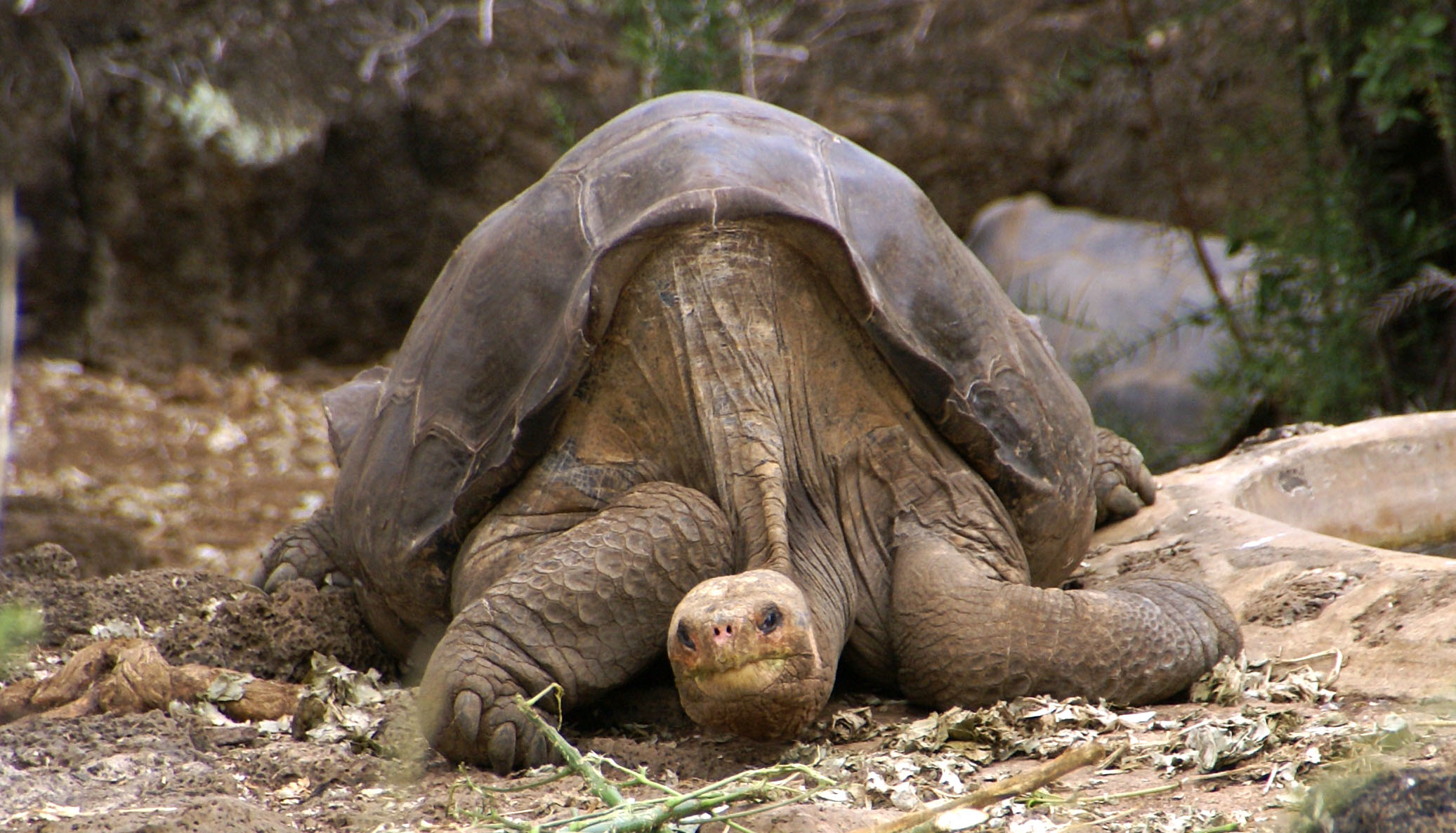
How I can start up something big enough I haven't the foggiest clue, but I feel we should do something. We could use advanced cloning to go and make more animals, with which we could start a new race, or maybe expand on existing animal species. For example, there is one Galapagos turtle left, and he's captive. So, we just take some of Lonesome George's DNA, put in a lab, inject it into a generic egg, and we have another turtle! The turtles could breed just before George dies (He's somewhere around 100). If we could do that, we could revive so many species...
Think, we could have T-rexes running around, we could frolic in the flowers with dodo birds, we could even study golden toads!
Then the world would be great! We could even cross breed and make a few animals of our own!

This is Lonesome George. Maybe someday soon he'll have a mate...
Hopefully, some of you reading this are interested in cloning, and might fulfill my legacy with me. When I grow up, I want to do many things, but I'd really love to give George a female buddy he can mate with. Then he can die happy.
The citation-
"Lonesome George." Wikipedia. 16/08/09. Web
1. Read another blog.
2. Stare at the sun so you go blind, then read.
3. Walk away.
If you're still reading this, I'm presuming you aren't easily bored, and so I will now continue with my post.
I've always thought of one thing, now more than ever since I'm now doing Wild Malaysia- the world was fine until we came along. Yes, we are an intelligent life form, and it may be good to have a few of those on the planet, but we have single-handedly destroyed our world. Our economy is crashing, our politics suck, and the prices of everything are on the rise. Those are our problems, but have we ever thought of something other than ourselves? There are loads of endangered and extinct species out in the wild, and majority of them are endangered/extinct because of us. We have to cut down their environment for another condominium, or hunt them to make a quick buck. I feel sorry for many animals, and want to help them.
How I can start up something big enough I haven't the foggiest clue, but I feel we should do something. We could use advanced cloning to go and make more animals, with which we could start a new race, or maybe expand on existing animal species. For example, there is one Galapagos turtle left, and he's captive. So, we just take some of Lonesome George's DNA, put in a lab, inject it into a generic egg, and we have another turtle! The turtles could breed just before George dies (He's somewhere around 100). If we could do that, we could revive so many species...
Think, we could have T-rexes running around, we could frolic in the flowers with dodo birds, we could even study golden toads!
Then the world would be great! We could even cross breed and make a few animals of our own!

This is Lonesome George. Maybe someday soon he'll have a mate...
Hopefully, some of you reading this are interested in cloning, and might fulfill my legacy with me. When I grow up, I want to do many things, but I'd really love to give George a female buddy he can mate with. Then he can die happy.
The citation-
"Lonesome George." Wikipedia. 16/08/09. Web
Subscribe to:
Posts (Atom)